We Stopped Trying to Beat AI Detectors When We Realized What They Were Actually Detecting

A few months ago, we were looking at an article that had taken us most of the afternoon to finish. We had researched the subject, checked several sources, rewritten the introduction twice, and spent a ridiculous amount of time trying to make the conclusion sound less repetitive.
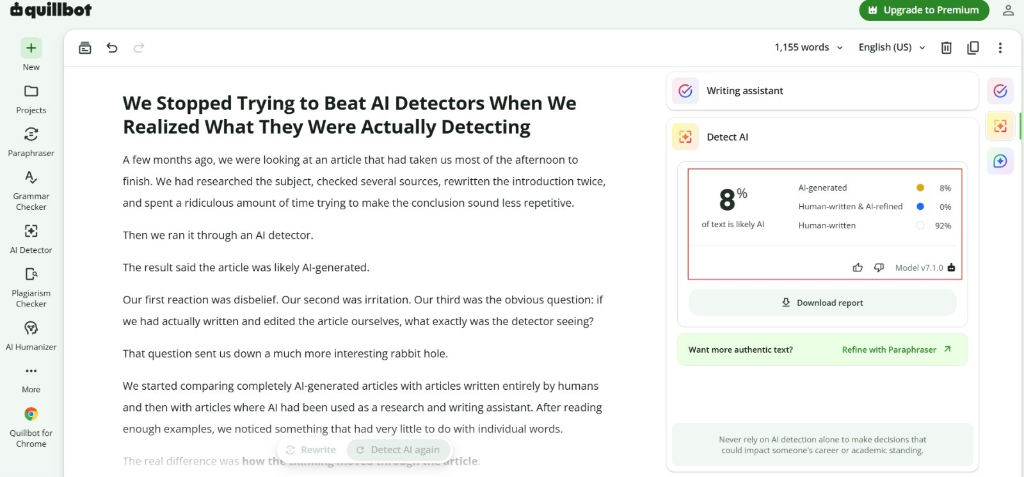
Then we ran it through an AI detector.
The result said the article was likely AI-generated.
Our first reaction was disbelief. Our second was irritation. Our third was the obvious question: if we had actually written and edited the article ourselves, what exactly was the detector seeing?
That question sent us down a much more interesting rabbit hole.
We started comparing completely AI-generated articles with articles written entirely by humans and then with articles where AI had been used as a research and writing assistant. After reading enough examples, we noticed something that had very little to do with individual words.
The real difference was how the thinking moved through the article.
AI Doesn't Necessarily Write Badly. It Writes Differently.
There is a temptation to talk about AI writing as though it is automatically poor quality.
That is no longer true.
AI can write cleaner first drafts than many people. It can explain complicated subjects without getting lost, summarize research quickly, generate examples, suggest headlines, and identify angles that a writer might not have considered.
The problem appears when that efficiency becomes visible in the writing.
Have you ever read an article where every paragraph seems to know exactly where it is going?
The introduction introduces the subject. The next section explains the problem. Then come the causes, followed by solutions, followed by benefits, followed by a neat conclusion that summarizes everything you have just read.
There is nothing technically wrong with it.
And yet, after a while, you begin to feel that you have seen the article before.
That feeling is important.
Because human beings do not always think in such a perfectly organized way.
Think About How We Actually Write
When we sit down to write about something we understand, we don't usually have the entire article in our heads.
We might know the subject and have a rough idea of what we want to say, but the actual argument develops while we are writing.
An example reminds us of something that happened previously. That memory makes us question one of our assumptions. We search for some data to see whether our memory is actually representative. Then we discover something that doesn't quite support our original position.
So we change the argument.
That is how thinking often works.
It is not a straight line.
It is more like a funnel.
We begin with something broad and abstract, gradually collect experiences and information around it, eliminate what doesn't matter, and eventually arrive at something specific enough to say with confidence.
The process might look like:
Idea → curiosity → experience → research → doubt → comparison → realization → conclusion
AI can imitate that process, but it does not naturally need to go through it in the same way.
When we ask an AI to write about a familiar subject, it already has access to patterns surrounding that subject. It can identify the major concepts, common arguments, frequently used examples, and likely conclusion almost immediately.
That makes it incredibly efficient.
It can also make the resulting article feel incredibly predictable.

The Information Advantage Is Real
This is where we think we sometimes misunderstand the relationship between humans and AI.
AI is better than humans at dealing with enormous quantities of information.
There is no point pretending otherwise.
If we spend three hours researching a topic, we might read ten or fifteen useful articles, follow a few references, compare some statistics, and save a handful of notes.
AI can work across an enormous body of information and identify relationships much faster.
But there is a trade-off.
We don't simply consume information.
We interpret it through our limitations.
We might read ten articles and remember one particular example because it reminds us of something that happened to a client. Another statistic may seem less important because we know from experience that the situation behind it is more complicated.
In other words, humans are selective.
Sometimes that is a weakness.
Sometimes it is precisely what gives writing a point of view.
AI asks, in effect, “What information belongs to this topic?”
A human writer eventually asks a more personal question:
That is a different kind of intelligence.
This Is Where Emotional Depth Comes In
People often misunderstand what “emotional writing” means.
It does not mean filling an article with words such as powerful, exciting, frustrating, and meaningful.
Those are simply emotional labels.
Real emotional depth usually comes from experience.
Imagine two people writing about losing a major client.
One writes:
The sentence is perfectly reasonable.
The other writes:
The second version works because it contains observation.
There is a person noticing something.
There is context.
There is a small story.
There is uncertainty.
And there is a consequence waiting at the end of it.
AI can certainly generate a sentence like that.
But the writers who actually experienced it can add details that make the story specific rather than merely plausible.
That distinction matters.
Human Writers Are Not Always More Data-Driven
This is another interesting difference.
AI tends to have an enormous appetite for information. When asked to explain a subject, it often wants to give you everything that might be relevant.
Human writers generally cannot do that.
We don't remember everything we have ever read. We cannot compare thousands of sources simultaneously. We make choices based on what we know, what we have experienced, and what we discover while researching.
That limitation creates editorial judgment.
We might deliberately leave out five interesting statistics because one particular example explains the argument better.
AI might include all six because all six are relevant.
We are asking, “What should we tell the reader?”
AI is often better at asking, “What can we tell the reader?”
Those sound similar, but they lead to different articles.
The Continuity Problem Is More Subtle
The biggest difference becomes visible when we stop reading individual paragraphs and read the entire article.
AI can produce paragraphs that are individually excellent.
We can read one and think, “That's a really good explanation.”
Then we read the next one and think exactly the same thing.
Then another.
Eventually, something feels wrong.
The paragraphs aren't bad.
They just aren't necessarily talking to each other.
Human writers tend to carry emotional and intellectual context from one paragraph into the next. If we tell you a story at the beginning, we may return to it later. If we make an argument and then discover a contradiction, we may address that contradiction in the next section.
The article evolves.
AI can create continuity too, particularly with careful prompting and editing, but it is one of the places where human review becomes extremely valuable.
We need someone asking, “Why is this paragraph here?”
Not whether the paragraph is well written.
Why it is there.
Those are different questions.
The Three Versions of the Same Article
This becomes clearer if we imagine three writers receiving the same assignment.
The first tells AI:
The result will probably be structured, comprehensive, and reasonably polished.
The second writer researches the subject independently and writes from experience. Their article may contain fewer statistics but more specific observations, examples, disagreements, and personal conclusions.
The third writer uses AI differently.
They research with AI. They ask it to identify competing viewpoints. They use it to organize notes and point out gaps. They may even ask it to challenge their own argument.
Then they take all of that material and write the article themselves.
The third approach is where we think the most interesting future of content creation lies.
It isn't really AI versus human.
It is AI as an amplifier of human thinking.
So, How Do You Actually Get Away From “AI-Looking” Writing?
This is where the phrase “tricking AI detectors” becomes misleading.
If your entire strategy is to manipulate a detector, you can end up producing terrible writing.
People sometimes try to insert deliberate grammatical mistakes, replace ordinary words with strange synonyms, vary sentence structures mechanically, or add random personal-sounding phrases.
But a human reader doesn't need an AI detector to recognize unnatural writing.
They simply stop reading.
The better approach is to make the content genuinely more human.
Start before you open the AI tool.
Write down what you already think.
Don't worry about whether it is organized. If you have a strong opinion, write it down. If you disagree with the conventional wisdom, write that down too. If you remember an experience that seems only loosely connected to the subject, include it.
That messy material is valuable because it comes from you.
Then use AI.
Ask it to research the topic. Ask it what you might be missing. Ask it to argue against you. Ask it to identify weak assumptions. Ask it to help organize your notes.
But don't immediately accept the resulting article as the final version.
Use the AI output as raw material.
Then make the argument yours.
Don't Ask AI to “Sound Human”
This may be one of the least useful prompts you can give an AI.
What does that actually mean?
AI doesn't know your version of human.
It can only infer what people generally associate with human writing.
Instead, give it context.
Tell it who the audience is.
Tell it what you believe.
Give it examples from your experience.
Explain what you disagree with.
Tell it which parts of the argument you are uncertain about.
The prompt becomes less like a command and more like a conversation.
For example, instead of:
try something closer to:
Now AI has something real to work with.
It has our argument, our uncertainty, and our direction.
That produces much better material than a rigid instruction containing nothing except a topic and word count.
The Best “Imperfections” Are Not Mistakes
There is a strange trend around AI writing where people think humanizing content means deliberately making it worse.
We don't agree.
Human writing doesn't need artificial mistakes.
What it needs is individuality.
A human writer may use a long sentence because the thought is complicated and then follow it with a shorter sentence because the point has finally landed.
They may interrupt their argument with an example.
They may admit that they changed their mind.
They may say something that is slightly uncomfortable because it is what they genuinely believe.
Those are not mistakes.
They are choices.
And good human editing should preserve those choices rather than flattening everything into the same polished rhythm.
The Experience Test
There is one test we like more than an AI detector.
Read your article and ask:
If the answer is nowhere, there is probably an opportunity to make the article stronger.
You don't need to turn every blog into a personal diary. That would be ridiculous.
But even a technical article can contain perspective.
If you're writing about SEO, explain what you've actually seen happen.
If you're writing about branding, describe an assumption that a client had to reconsider.
If you're writing about productivity, explain which technique worked for you and which one turned out to be useless.
If you're writing about technology, talk about what surprised you when you actually used it.
Information tells people what something is.
Experience tells them what it means.
And That's Where the Real Difference Appears
After spending time comparing AI-generated, human-generated, and AI-assisted writing, we stopped being particularly interested in whether a detector could identify something as AI.
The more interesting question became whether a reader could feel a human mind behind the article.
That is a much harder standard.
A detector looks for patterns in language.
A reader looks for intention.
A detector can notice predictable sentence structures.
A reader notices when the writer has nothing new to say.
A detector can analyze word choices.
A reader notices whether the writer actually understands the subject.
That is why trying to “beat” AI detectors is ultimately the wrong goal.
The goal should be to create content with enough human thinking that the detector becomes almost irrelevant.
Use AI for speed.
Use it for research.
Use it for brainstorming.
Use it to challenge your assumptions and help you see possibilities you might have missed.
But bring your own experience back into the room.
Bring your judgment.
Bring your uncertainty.
Bring the story you almost left out because you weren't sure it belonged.
That is where good writing usually begins.
And perhaps the irony is that the best way to make AI-assisted writing feel human isn't to learn how to fool a machine.
It is to stop writing for the machine in the first place.
Write for the person on the other side of the screen.